Thursday, April 5, 2012

Munich and Vienna: Part 1 - Munich


Just two days after my return from Barcelona, I set off once again; this time to Germany and Austria. This trip was a weeklong trip over St. Patrick’s Day to Munich and Vienna. My traveling companion was my friend Jeremiah, who had traveled to Barcelona with me. The train to Munich left from Paris and took a little over eight hours to get there, which was surprising to me (I thought it would take longer). We got to Munich at around 9 p.m. and went straight to our hostel and went to bed to prepare for the next day.

We woke up early so we get do as much as we could during the two days we had before departing to Vienna. First we visited a place called Asamkirche or Asam’s Church. It was built in the mid 1700’s by the Asam brothers as their private church. Due to resistance of the citizens, the brothers were forced to make the church accessible to the public. It is an example of the excessively ornate Baroque style of architecture. Since it was built as a private church, it was built attached to their city home. After visiting the church we made our way to Munich’s Marienplatz, where we got to see the Glockenspiel play. We explored the area a bit and got some lunch. The food in Munich was delicious. After lunch we climbed to the top of a church tower to get a magnificent view of the city center.

After exploring the center of town, we ventured outward toward the Munich Olympic Park and the BMW Welt showroom. The Olympic Park was made up of swooping glass and metal structures that were suspended like fabric. It would have been fun to visit inside the stadiums, but they were performing some maintenance and we couldn’t get inside. We toured BMW Welt and saw some cool concept cars. We decided not to visit the museum because the price was a little steep for us and we wanted to save the money for other things. We then went back to the city center and visited the Englischer Gartens. A massive public park with several beer gardens inside. There is a small river that flows through the park and at a spot where it flows out from beneath a bridge, it creates a large wave. Locals have taken to surfing on this wave and are now somewhat famous. We then made a trip to the famous Hofbrauhaus for dinner. The Hofbrauhaus is a beer garden and restaurant. I had some great German food and beer. We ended the evening with a trip to see BMW Welt at night, because it looks its best when lit up at night.

The next day, we woke up early to visit the Dachau concentration camp. We took a commuter train out to Dachau and arrive at the memorial by bus. One thing that struck me about the complex was the fact that it is now in the middle of a German suburb. Once inside, it was a somber experience to say the least. If I had been by myself I might have been brought to tears with the knowledge that I was in a place where so much suffering and despair took place, but I wept for the dead in my heart. When we visited Dachau, I underestimated the size of it. Even more so, it was hard to imagine how many people were detained there. We explored the concentration camp with our audio guides and hardly uttered a word to one another. It was hard for us to fathom what we were or should have been feeling. Much of the camp was still intact except for the barracks’, which had been torn down years ago. A pair of reconstructed buildings was all that remained. At the back of the site, there were multiple religious shrines constructed in remembrance of those who were imprisoned for their faith. At the end of the complex were the furnaces for burning the bodies of the dead. The entire trip was surreal, but I’m glad I made it there. It was an experience I’m sure I won’t forget.


After visiting Dachau, we went back to the Munich train station to prepare for our next excursion, Neuschwanstein Castle. Our next destination was as opposite to Dachau as it gets. We started at a German concentration camp and were now going to visit a picturesque castle in the Alps. The train ride was two hours, so we had some time to process our trip to Dachau and get ready for Neuschwanstein. When we arrived we only had a couple of hours to explore before we had to catch the last available train back to Munich. We discovered that there actually two castles, both commissioned by King Ludwig of Bavaria (who bankrupted the country more than once to build them). Neuschwanstein Castle is perched atop a small mountain overlooking a beautiful valley and is reminiscent of a Disney Castle. Behind the castle is a magnificent view of the Alps. With little time to spare, we spent our two hours running around the mountains taking pictures of the castles. We had heard that it takes 40 minutes to walk up to Neuschwanstein, we did it in 15. After a bunch of climbing and running, we had to make our way back to the train. We headed back to Munich to prepare for our trip to Vienna.

Saturday, March 24, 2012

Barcelona Day Two: More Awesome Pictures

 The Entrance to Palau de la Musica Catalana

 The Barcelona Gothic Quarter and the Gothic Style Cathedral

 Cathedral Interior

 Cathedral Cloister

 Gothic Quarter and back to the Palau de la Musica Catalana for the Tour

 Tiny Sculptures


 Casa Mila by Antoni Gaudi

 The Dragon Gate at the Guell Pavilions


 A few more pictures from Park Guell

 Panorama of Barcelona

 Boats at Night

Spanish Countryside on the way back

Barcelona Day Two - Music and a Dragon


On the second day in Barcelona, my group met me at my hostel as it was very close to the first site we wanted to visit, the Palau de la Musica Catalana. It is a concert hall in Barcelona designed in the Catalan modernisme style by the architect Lluís Domènech i Montaner, it was built between 1905 and 1908. It has become a symbol for Catalan culture in Barcelona and contains a great deal of symbolism in its architecture. After remembering that this building was in Barcelona, I definitely wanted to see it. After we found it and took a few pictures of the exterior we headed to the ticket office to discover that they offer tours, and that you can’t get inside without joining one. So we signed up for the English language tour at one o’clock. This would give us time to eat lunch and explore some of Barcelona’s Gothic Quarter, a district with an impressive amount of neo-gothic architecture (though they market most of it as authentically historic gothic).

After getting the tickets, we headed down towards Barcelona’s old gothic cathedral. It was not unlike the many other gothic cathedrals I’ve seen up to this point, but to its credit, it had an amazing cloister. The cloister space was nestled in next to the cathedral and we almost stumbled on it by accident. It was an amazingly peaceful place (at least I assume it would be without the crowds of tourists). There were water fountains and reflecting pools as well as orange trees. The cloister also had a small flock of geese living in an enclosure constructed for them. We enjoyed this space for quite a while, before moving on to find lunch, after which we went down to see the boat docks and the bay. By this time we decided it would be best to head back and get ready for our tour.

When we returned to the concert hall, we joined a large tour group and set off to explore the building. At the onset of the tour, we were told that no pictures were to be taken of the interior, as the images of the building were licensed, so if the fine people at the Palau de la Musica Catalana are reading this I totally didn’t take any pictures… The tour was really interesting and the building itself is quite amazing. I would have loved to see a performance there, had I brought a more respectable change of clothes. The performance hall was magnificently ornate, with a massive stained glass bulb that hung down from the ceiling like a drop of water. We got to hear the organ behind the stage played for a few minutes by a computer. The computer was playing from recorded memory. The sound of the organ resonated through the hall and I can only image what it might be like to hear it as part of an actually performance. The tour concluded with a view from the top balcony before we were led back downstairs to the entrance hall. The images I saw that day will remain in my memory (card) the rest of my life.

After the tour, we headed off to find a work by Gaudi that had so far eluded us, a metal sculpture of a dragon adorning a gateway to a garden. After visiting a gift shop in an apartment complex by Gaudi, we were able to find the location of the dragon in a book of his works. We found the location on our map and headed off to find it. When we arrived we discovered that the gate was to a garden facility, known as the Guell Pavilions, which is now owned and maintained by the University of Barcelona. It was not open to the public, at least on the day we visited. But that didn’t change the fact that the gate was what we had come to see, and it was really cool. The dragon was sitting across the top of the gate and was constructed with various shapes of sheet metal. The dragon’s mouth was wide open, as if to frighten any intruders away. This work was far more modest than the previous examples by Gaudi that we had seen, and was rather refreshing because of it. After we took our pictures we decided to head back to Park Guell, since we didn’t experience enough of it the first time.

So we climbed the hill back into Park Guell and split up, going our separate ways because I wanted to explore on my own for a while. I walked all the way around the park and back. It was nice to see some greenery after living in the barren north of France for the last month of February. It is important to note that while I am writing this in Lille, it is a cool 66 degrees Fahrenheit. After a relaxing walk through the park, we headed off to find dinner and then went to the bay area. It was our last night after an exhausting two days in Barcelona. We probably did three days worth of sightseeing in two. At the end we got some ice cream and called it a night. The next morning we went to the train station to begin our journey home. The train ride back was stressful and frustrating but I won’t get into why. I figure I’ve made you read enough already.

Barcelona Day One: The Really Awesome Pictures

A Brief Stop in Montpelier
Casa Batllo at Night

The Two Completed Facades of Sagrada Familia

 The Exterior is Adorned with Hundreds of Sculptures Depicting Scenes from The Bible
The Interior is Beyond Explanation

 The Magnificent and Astounding Interior


 Barcelona from a Tower of Sagrada Famila


 These are only a couple of pictures of Park Guell

Casa Batllo

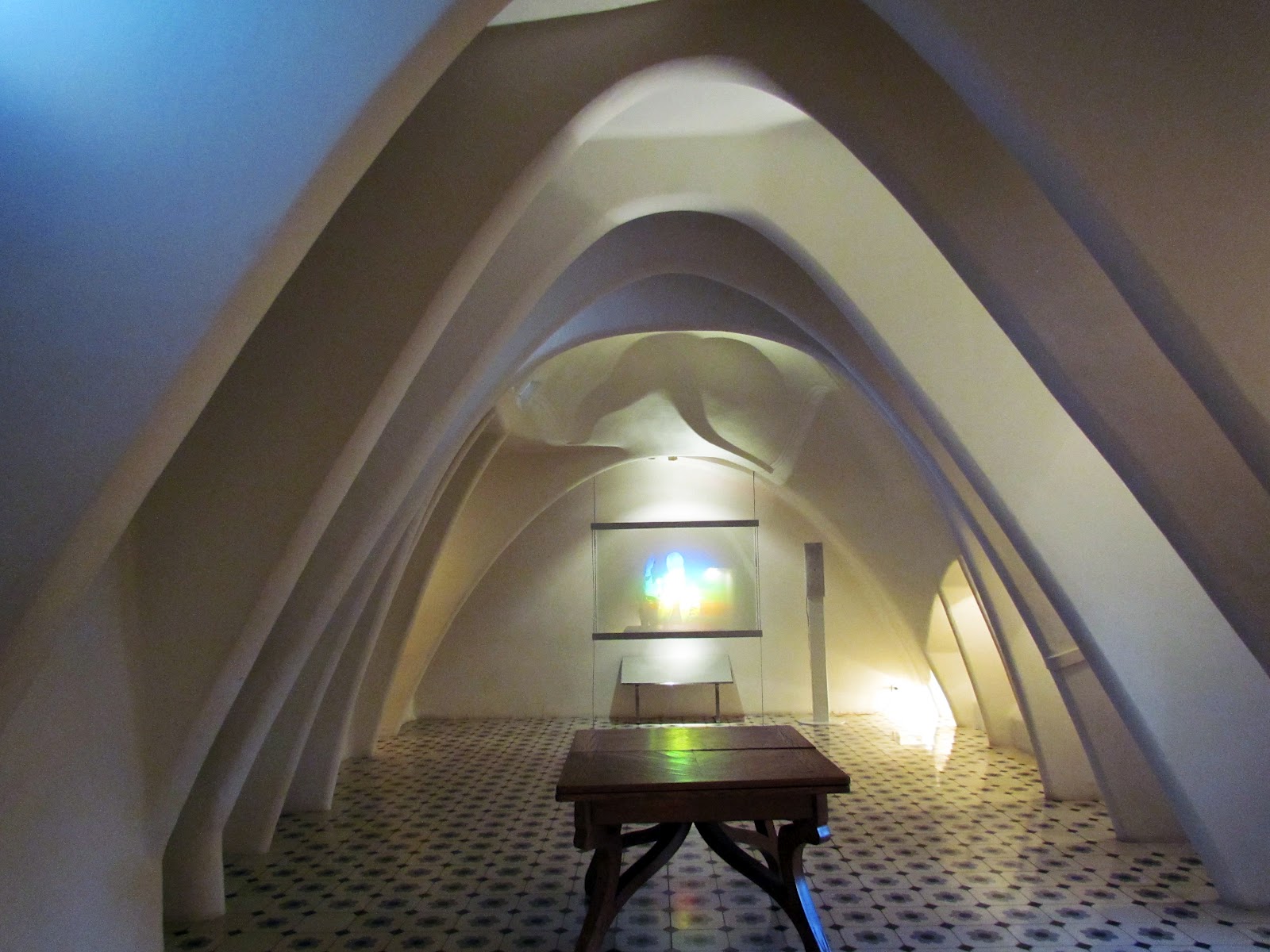
 Gaudi was a master of controlling interior spaces. Walking around inside Casa Batllo is like walking through a living organism.

 This Attic is better than any one you've ever seen.

 The Back of a Dragon

Paella


I wish i could post more of the pictures i took of Sagrada Familia, Park Guell, and Casa Batllo. I took nearly 1000 pictures in the first day in Barclona. It would be impractical to post even 1/10th of the pictures I took.

Friday, March 23, 2012

Barcelona: Day One - Antoni Gaudi


Barcelona is a city I have wanted to visit for a while. When I first arrived in Lille I didn’t think I would make it there. It’s a popular place to visit and trains fill up fast. In spite of this was able to get tickets. I left for Barcelona on Thursday morning, prepared for an entire day on trains. I spent the first leg of the trip traveling to Montpellier, a city in the south of France. I had a four hour layover and got to explore a little of the city. It’s a nice city but four hours is all you need to see it. I’ve been slowly learning to use my new camera (which was given to me by my father after he deemed it too complicated for him). I took some cool artistic pictures with different camera settings. After the layover we boarded a train to Figueres, a city across the border into Spain; then finally to Barcelona. We arrived after 10 at night, but the weather was good (as it always is in Barcelona) so we walked to our hostels. I was staying in a different hostel than my traveling companions. On the way there, we came across Casa Batllo, a home designed by Catalan architect Antoni Gaudi. It was a magnificent example of Catalan art nouveau and looked even better when lit up at night. It was a pleasant first sight for our arrival in Barcelona. After taking a few pictures and just enjoying the experience, we left to find our hostels. I then checked in at my hostel and went to bed.

The next day we decided to meet a Sagrada Familia, Gaudi’s famous Basilica that has been under construction for decades. After leaving the hostel I made my way over to the massive church. Because I could not see it from a distance (despite its towering height) I was eager to get my first glimpse of the grand basilica. I when I first saw it I was awestruck. The towers are so tall but contain such incredible and delicate detail that it’s impossible to take it all in at once. The basilica wasn’t even at its final height; the primary towers have not yet been constructed. After taking a quite a few pictures I moved to the other side of the church, which was just as magnificent, if not more so. I met up with my group and we made our way inside the church. We were disappointed to find fences and gates around the church; the security was very tight. This fact, however, is put into context with the knowledge that an arsonist tried to burn down the church a few years back. There was minimal damage and no one was harmed, but it proves that there are people who would seek to do harm to this great church.

The interior of the church is beyond my ability to describe. I cannot do justice to the bizarre interior. The architecture is much more than fascinating, it’s entrancing. Entering the church is like walking to a place of myth and legend, a grand and ancient temple. It doesn’t feel like it’s been conceived by a human mind, but by nature itself.  I could on for pages describing what I saw in just those first few minutes. After exploring the interior of the church (and taking ridiculous number of pictures) we head to the elevator which would take us to the top of one of the towers. The top provided us with a magnificent view of the city.  The stairs in the tower were narrow and steep. Climbing down the tower also gave us an interesting view of the construction. When we made our way down and reentered the church, we spent another hour or so trying to understand the space and the experience. Eventually we had to leave, as there were many other sites in Barcelona to see. We were slow to leave and I wonder now whether or not I should have stayed longer.

After Sagrada Familia, we went to another of Gaudi’s creations, Park Guell. It is an expressive blend between manmade structures and natural ones. Gaudi took many of his inspirations from nature, so it makes sense that he would design a park. The park has many different underpasses, overhangs, and walkways, all made of stone. The stone work held together by what, I imagine, must be concrete. The stone structures look like they might be found in the Flintstones. Some of the features of the park work very well with the nature around them, creating exciting environments to explore and experience. Some of Gaudi’s features are so interesting though, that they distract from the rest of the park. Upon entering from the front of the park, you are greeted by three ornate buildings designed by Gaudi, and a large Iguana covered in mosaic tiles. Behind the iguana is a large plateau held up by a several rows of columns. The majority of the people spend their time posing for pictures with the iguana and sitting on the plateau, pretty much making them impossible to interact with properly. Crowds aside, the park was very interesting. We left the park to see one more of Gaudi’s works before the day was over, so we returned to Casa Batllo.

Casa Batllo is a house remodeled by Gaudi, though it looks like it was designed by him from the beginning. The building looks very remarkable — like everything Gaudí designed. The ground floor, in particular, looks astonishing with tracery, asymmetrical oval windows and gracefully sculpted stone work. Like many of Gaudi’s works, the building is adorned with mosaic tiles. The house contains many a subtle homage to St. George, the Patron Saint of Catalonia, and the legend of him slaying a dragon. I found the house to be almost as inspiring as Victor Horta’s House (the single greatest example of architecture I have had the privilege to experience). The complex curves of the interior walls and ceilings make me wonder why no one ever tried these things before. It was discovering a whole wealth of techniques that on one has ever thought to use. The house seemed to be inspired by the realm aquatic. A friend of mine once described it as “Gaudi’s Atlantis House”.

After visiting Casa Batllo we found a place to eat dinner. I had Paella. After an extremely long day we parted ways and I returned to my hostel and went to bed, eager for the next day.